Showing posts with label as discussed in class. Show all posts
Showing posts with label as discussed in class. Show all posts
Monday, December 20, 2010

Wednesday, December 15, 2010
Open-Mindedness
Here's an entertaining 10-minute video on open-mindedness, science, and paranormal beliefs.
I like the definition of open-mindedness offered by this video: it is being open to new evidence. This brings with it a willingness to change your mind... but only if new evidence warrants such a change.
Changing your mind has gotten a bum rap lately: flip-flopping can kill a political career. But willingness to change your mind is an important intellectual virtue that is valued by scientists.
Tuesday, December 14, 2010
Final Exam
Just a reminder: the final exam is Monday, December 20th, from 1:30 to 2:30 p.m. in our normal classroom.
Monday, December 13, 2010
Intellectual Humility
I think there’s an important connection between intellectual honesty and humility. A simple goal of this class is to get us all to recognize what counts as good evidence and what counts as bad evidence for a claim. I think we've gotten pretty good at this so far. But this doesn’t guarantee that we’ll care about the difference once we figure it out.
Here are the first two paragraphs of an interesting article on this:
Getting us to care is the real goal. We should care about good evidence. We should care about evidence and arguments because they get us closer to the truth. When we judge an argument to be overall good, THE POWER OF LOGIC COMPELS US to believe the conclusion. If we are presented with decent evidence for some claim, but still stubbornly disagree with this claim for no strong reason, we are just being irrational. Worse, we’re effectively saying that the truth doesn’t matter to us.
Instead of resisting, we should be open-minded. We should be willing to challenge ourselves--seriously challenge ourselves--and allow new evidence change our current beliefs if it warrants it. We should be open to the possibility that we’ve currently gotten something wrong. This is how comedian Todd Glass puts it:
Here are the first two paragraphs of an interesting article on this:
Last week, I jokingly asked a health club acquaintance whether he would change his mind about his choice for president if presented with sufficient facts that contradicted his present beliefs. He responded with utter confidence. “Absolutely not,” he said. “No new facts will change my mind because I know that these facts are correct.”
I was floored. In his brief rebuttal, he blindly demonstrated overconfidence in his own ideas and the inability to consider how new facts might alter a presently cherished opinion. Worse, he seemed unaware of how irrational his response might appear to others. It’s clear, I thought, that carefully constructed arguments and presentation of irrefutable evidence will not change this man’s mind.
Ironically, having extreme confidence in oneself is often a sign of ignorance. Remember, in many cases, such stubborn certainty is unwarranted.

Sunday, December 12, 2010
Metacognition
 There's a name for all the studying of our natural thinking styles we've been doing in class lately: metacognition. When we think about the ways we think, we can vastly improve our learning abilities. This is what the Owning Our Ignorance club is about.
I think this is the most valuable concept we're learning all semester. So if you read any links, I hope it's these two:
Saturday, December 11, 2010
Practical Advice
How can we counteract these cognitive biases we're learning about? One big point is to own our fallibility. Awareness of our limits and biases should lead us to lower our degree of confidence in our beliefs. Simply put, we should admit (and sincerely believe) that there's a real chance that we're wrong.
Here are two other big, simple points I think make for some great practical advice:
Here are two other big, simple points I think make for some great practical advice:
- A
 ctively seek out sources that you disagree with. We tend to surround ourselves with like-minded people and consume like-minded media. This hurts our chances of discovering that we've made a mistake. In effect, it puts up a wall of rationalization around our preexisting beliefs to protect them from any countervailing evidence.
- When we do check out our opponents, it tends to be the obviously fallacious straw men rather than sophisticated sources that could legitimately challenge our beliefs. But this is bad! We should focus on the best points in the arguments against what you believe. Our opponents' good points are worth more attention than their obviously bad points. Yet we often focus on their mistakes rather than the reasons that hurt our case the most.
Friday, December 10, 2010
Status Quo Bias
Lazy, inert humans:
- If it already exists, we assume it's good.
- Our mind works like a computer that depends on cached responses to thoughtlessly complete common patterns.
- NYU psychologist John Jost does a lot of work on that thing I asked you to look up for extra credit: system justification theory. This is our tendency to unconsciously rationalize the status quo, especially unjust social institutions. Scarily, those of us oppressed by such institutions have a stronger tendency to justify their existence.
- Jost has a new book on this stuff. Here's a video dialogue about his research:
Tuesday, December 7, 2010
Let's All Nonconform Together
If you like these links, I'll let you in my exclusive club:
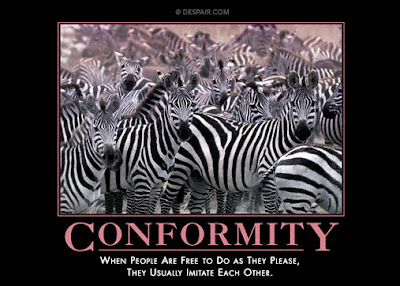
- On the influence of your in-groups and the formation of your identity: "If you want to set yourself apart from other people, you have to do things that are arbitrary, and believe things that are false." (from Paul Graham's "Lies We Tell Our Kids.")
- Here's a summary of two recent studies which suggest that partisan mindset stems from a feeling of moral superiority.
- Here's that poll showing the Republican-Democrat switcharoo regarding their opinion of Fed Chairman Ben Bernanke when the executive office changed parties.
- Our political loyalties also influence our view on the economy.
- Here's an article about a cool study on the relationship between risk and provincialism.
- Conformity hurts the advancement of science.
Monday, December 6, 2010
Wished Pots Never Boil
Here is a hodgepodge of links on some psychological impediments we're discussing recently:
- If you're a fan of The Secret, you should beware that it's basic message is wishful thinking run amok.
- Teachers have biases, too: we're self-serving and play favorites.
- Why don't we give more aid to those in need? Psychological impediments are at least partly to blame.
- Why do we believe medical myths (like "vitamin C cures the common cold," or "you should drink 8 glasses of water a day")? Psychological impediments, of course!
Monday, November 29, 2010
The Smart Bias
Oddly, the I'M-SPECIAL-ism bias seems to increase the more intelligent you are. Studies suggest that the smarter and more experienced you are, the more overconfident you're likely to become. In particular, we seem to believe that our intelligence makes us immune to biases. But that's just not true! The philosopher Nigel Warburton puts it nicely:
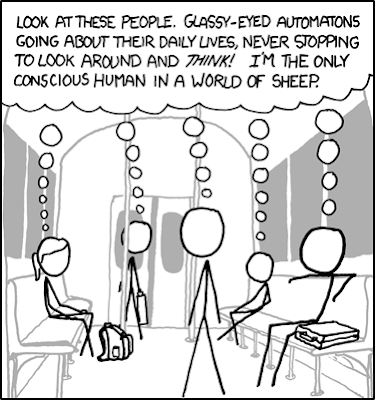
“Many of us would like to believe that intellect banishes prejudice. Sadly, this is itself a prejudice.”
Sunday, November 28, 2010
No, You're Not
One of my favorite topics is I'M-SPECIAL-ism. Psychological research has repeatedly shown that most Americans overestimate their own abilities. This is one of the biggest hurdles to proper reasoning: the natural tendency to think that we're more unique--smarter, or more powerful, or prettier, or whatever--than we really are.
You've probably noticed that one of my favorite blogs is Overcoming Bias. Their mission statement is sublimely anti-I'M-SPECIAL-ist:
So I hope you'll join the campaign to end I'M-SPECIAL-ism.
You've probably noticed that one of my favorite blogs is Overcoming Bias. Their mission statement is sublimely anti-I'M-SPECIAL-ist:
This may sound insulting, but one of the goals of this class is getting us to recognize that we're not as smart as we think we are. All of us. You. Me! That one. You again. Me again!"How can we better believe what is true? While it is of course useful to seek and study relevant information, our minds are full of natural tendencies to bias our beliefs via overconfidence, wishful thinking, and so on. Worse, our minds seem to have a natural tendency to convince us that we are aware of and have adequately corrected for such biases, when we have done no such thing."
So I hope you'll join the campaign to end I'M-SPECIAL-ism.
Saturday, November 27, 2010
The Importance of Being Stochastic
Statistical reasoning is incredibly important. The vast majority of advancements in human knowledge (all sciences, social sciences, medicine, engineering...) is the result of using some kind of math. If I had to recommend one other course that could improve your ability to learn in general, it'd be Statistics.
Anyway, a few links:

Anyway, a few links:
- I brought up this article before, but I'll mention it again: most of us are pretty bad at statistical reasoning.
- That radio show I love recently devoted an entire episode to probability:
- Here's a review of a decent book (The Drunkard's Walk: How Randomness Rules Our Lives) on our tendency to misinterpret randomness as if it's an intentional pattern.
- This ability to see patterns where there are none may explain why so many of us believe in god (see section 5 in particular).
- What was that infinite monkey typewriter thing we were talking about in class?
- What's up with that recent recommendation that routine screenings for breast cancer should wait to your 50s rather than 40s? Math helps explain it.
- Another radio show I love ran a great 2-part series on the screening for diseases called "You Are Pre-Diseased":
Listen to Episode 1
- Statistics in sports is all the rage lately. It can justify counterintuitive decisions, like going for it instead of punting on 4th down... though don't expect the fans to buy that fancy math learnin'.
Thursday, November 25, 2010
The Conspiracy Bug
Here's an article on a 9/11 conspiracy physicist that brings up a number of issues we're discussing in class (specifically appealing to authority and confirmation bias). I've quoted an excerpt of the relevant section on the lone-wolf semi-expert (physicist) versus the overwhelming consensus of more relevant experts (structural engineers):

While there are a handful of Web sites that seek to debunk the claims of Mr. Jones and others in the movement, most mainstream scientists, in fact, have not seen fit to engage them.And one more excerpt on reasons to be skeptical of conspiracy theories in general:
"There's nothing to debunk," says Zdenek P. Bazant, a professor of civil and environmental engineering at Northwestern University and the author of the first peer-reviewed paper on the World Trade Center collapses.
"It's a non-issue," says Sivaraj Shyam-Sunder, a lead investigator for the National Institute of Standards and Technology's study of the collapses.
Ross B. Corotis, a professor of civil engineering at the University of Colorado at Boulder and a member of the editorial board at the journal Structural Safety, says that most engineers are pretty settled on what happened at the World Trade Center. "There's not really disagreement as to what happened for 99 percent of the details," he says.
One of the most common intuitive problems people have with conspiracy theories is that they require positing such complicated webs of secret actions. If the twin towers fell in a carefully orchestrated demolition shortly after being hit by planes, who set the charges? Who did the planning? And how could hundreds, if not thousands of people complicit in the murder of their own countrymen keep quiet? Usually, Occam's razor intervenes.
Another common problem with conspiracy theories is that they tend to impute cartoonish motives to "them" — the elites who operate in the shadows. The end result often feels like a heavily plotted movie whose characters do not ring true.
Then there are other cognitive Do Not Enter signs: When history ceases to resemble a train of conflicts and ambiguities and becomes instead a series of disinformation campaigns, you sense that a basic self-correcting mechanism of thought has been disabled. A bridge is out, and paranoia yawns below.
Wednesday, November 24, 2010
Rationalizing Away from the Truth
A big worry that the confirmation and disconfirmation biases raise is the difficulty of figuring out what counts as successful, open-minded reasoning, versus what amounts to after-the-fact rationalization of preexisting beliefs. Here are some links on our tendency to rationalize rather than reason:
- Recent moral psychology suggests that we often simply rationalize our snap moral judgments. (Or worse: we actually undercut our snap judgments to defend whatever we want to do.)
- The great public radio show Radio Lab devoted an entire show to the psychology of our moral decision-making:
- Humans' judge-first, rationalize-later approach stems in part from the two competing decision-making styles inside our heads.
- For more on the dual aspects of our minds, I strongly recommend reading one of the best philosophy papers of 2008: "Alief and Belief" by Tamar Gendler.
- Here's a video dialogue between Gendler and her colleague (psychologist Paul Bloom) on her work:
Saturday, November 20, 2010
More to Forget
Here's more on the less of memory:

- Here's an overview on the way our memory is faulty by psychologist Gary Marcus. He's written a book called Kluge: The Haphazard Construction of the Human Mind.
- Even strong "flashbulb memories" like what you were doing on 9/11 are not very accurate.
- One leading expert on memory is psychologist Elizabeth Loftus. Here is a pair of articles that summarize her research on false memories, and here's a video of her presenting on it.
Thursday, November 18, 2010
Filling In Memory
Here's a section (pages 78-80) from psychologist Dan Gilbert's great book Stumbling on Happiness about how memory works:
The preview cuts off at the bottom of page 80. Here's the rest from that section:
Fine. Here's Dan Gilbert on The Colbert Report:
The preview cuts off at the bottom of page 80. Here's the rest from that section:
"...reading the words you saw. But in this case, your brain was tricked by the fact that the gist word--the key word, the essential word--was not actually on the list. When your brain rewove the tapestry of your experience, it mistakenly included a word that was implied by the gist but that had not actually appeared, just as volunteers in the previous study mistakenly included a stop sign that was implied by the question they had been asked but that had not actually appeared in the slides they saw.Too many words, Sean! Can't you just put up a video? You better make it funny, too!
"This experiment has ben done dozens of times with dozens of different word lists, and these studies have revealed two surprising findings. First, people do not vaguely recall seeing the gist word and they do not simply guess that they saw the gist word. Rather, they vividly remember seeing it and they feel completely confident that it appeared. Second, this phenomenon happens even when people are warned about it beforehand. Knowing that a researcher is trying to trick you into falsely recalling the appearance of a gist word does not stop that false recollection from happening."
Fine. Here's Dan Gilbert on The Colbert Report:
Monday, November 15, 2010
Direct Experience
Here's two videos on stuff we've been talking about in class lately. First, watch this:
Next, watch this:
Finally, here's an article on this issue. Still trust your direct experience?
Next, watch this:
Finally, here's an article on this issue. Still trust your direct experience?
Saturday, November 13, 2010


Friday, November 12, 2010
Ask Friends... Old Friends
Here's a case for more deference in our lives from one of my favorite websites:

- Often times, our friends know more about us than we do.
- While talking to your friends, you might want to ask more about them. It turns out that they're less like us than we might think.
- Also, consider listening to advice from older people. We're not as different from them as we think.
Thursday, November 11, 2010
All Email Forwards are False?
I got the following email last Spring:

-------------- Forwarded Message: --------------Here was my response:
From: Papa Landis
To: Mama Landis; Me; My Twin; My Older Brother; My Older Sister
Subject: Fw: Really Important After Sunday's Vote
-------------- Forwarded Message: --------------
Forwarded by Colleague
To: Papa Landis [and dozens more]
-------------- Forwarded Message: --------------
From: Friend of Colleague
To: [Dozens]
.
.
.
From: Gilbert Turrentine (original source?)
Subject: Really Important After Sunday's Vote
I have passed it onto over 100~~~please pass on to how ever many you can.
Really Important After Sunday's Vote
It may well be time for this approach; it's tough to argue against the principle! This will take less than thirty seconds to read. If you agree, please pass it on.
An idea whose time has come
For too long we have been too complacent about the workings of Congress. Many citizens had no idea that members of Congress could retire with the same pay after only one term, that they didn't pay into Social Security, that they specifically exempted themselves from many of the laws they have passed (such as being exempt from any fear of prosecution for sexual harassment) while ordinary citizens must live under those laws. The latest is to exempt themselves from the Healthcare Reform that is being considered...in all of its forms. Somehow, that doesn't seem logical. We do not have an elite that is above the law. I truly don't care if they are Democrat, Republican, Independent or whatever. The self-serving must stop. This is a good way to do that. It is an idea whose time has come.
...
Proposed 28th Amendment to the United States Constitution
"Congress shall make no law that applies to the citizens of the United States that does not apply equally to the Senators and/or Representatives; and, Congress shall make no law that applies to the Senators and/or Representatives that does not apply equally to the citizens of the United States."
From: MeHis response to me:
To: Papa Landis
Subject: Re: Really Important After Sunday's Vote
The claims about Congress aren't true:
http://www.factcheck.org/2010/01/lawmaker-loopholes
From: Papa Landis
To: Me
Subject: Re: Really Important After Sunday's Vote
OK, thanks for that.
Subscribe to:
Posts (Atom)
