Showing posts with label I'M-SPECIAL-ism. Show all posts

Wednesday, December 15, 2010

Open-Mindedness

Here's an entertaining 10-minute video on open-mindedness, science, and paranormal beliefs.


I like the definition of open-mindedness offered by this video: it is being open to new evidence. This brings with it a willingness to change your mind... but only if new evidence warrants such a change.

Changing your mind has gotten a bum rap lately: flip-flopping can kill a political career. But willingness to change your mind is an important intellectual virtue that is valued by scientists.

Monday, December 13, 2010

Intellectual Humility

I think there’s an important connection between intellectual honesty and humility. A simple goal of this class is to get us all to recognize what counts as good evidence and what counts as bad evidence for a claim. I think we've gotten pretty good at this so far. But this doesn’t guarantee that we’ll care about the difference once we figure it out.

Getting us to care is the real goal. We should care about good evidence. We should care about evidence and arguments because they get us closer to the truth. When we judge an argument to be overall good, THE POWER OF LOGIC COMPELS US to believe the conclusion. If we are presented with decent evidence for some claim, but still stubbornly disagree with this claim for no strong reason, we are just being irrational. Worse, we’re effectively saying that the truth doesn’t matter to us.

Instead of resisting, we should be open-minded. We should be willing to challenge ourselves--seriously challenge ourselves--and allow new evidence change our current beliefs if it warrants it. We should be open to the possibility that we’ve currently gotten something wrong. This is how comedian Todd Glass puts it:


Here are the first two paragraphs of an interesting article on this:

Last week, I jokingly asked a health club acquaintance whether he would change his mind about his choice for president if presented with sufficient facts that contradicted his present beliefs. He responded with utter confidence. “Absolutely not,” he said. “No new facts will change my mind because I know that these facts are correct.”

I was floored. In his brief rebuttal, he blindly demonstrated overconfidence in his own ideas and the inability to consider how new facts might alter a presently cherished opinion. Worse, he seemed unaware of how irrational his response might appear to others. It’s clear, I thought, that carefully constructed arguments and presentation of irrefutable evidence will not change this man’s mind.

Ironically, having extreme confidence in oneself is often a sign of ignorance. Remember, in many cases, such stubborn certainty is unwarranted.

Certainty Is a Sign of Ignorance

Sunday, December 12, 2010

Metacognition

Next We Can Think About the Way We Think About ThinkingThere's a name for all the studying of our natural thinking styles we've been doing in class lately: metacognition. When we think about the ways we think, we can vastly improve our learning abilities. This is what the Owning Our Ignorance club is about.
I think this is the most valuable concept we're learning all semester. So if you read any links, I hope it's these two:

Saturday, December 11, 2010

Practical Advice

How can we counteract these cognitive biases we're learning about? One big point is to own our fallibility. Awareness of our limits and biases should lead us to lower our degree of confidence in our beliefs. Simply put, we should admit (and sincerely believe) that there's a real chance that we're wrong.

Here are two other big, simple points I think make for some great practical advice:
  1. AKirk & His Straw Bananactively seek out sources that you disagree with. We tend to surround ourselves with like-minded people and consume like-minded media. This hurts our chances of discovering that we've made a mistake. In effect, it puts up a wall of rationalization around our preexisting beliefs to protect them from any countervailing evidence.
  2. When we do check out our opponents, it tends to be the obviously fallacious straw men rather than sophisticated sources that could legitimately challenge our beliefs. But this is bad! We should focus on the best points in the arguments against what you believe. Our opponents' good points are worth more attention than their obviously bad points. Yet we often focus on their mistakes rather than the reasons that hurt our case the most.

Monday, November 29, 2010

The Smart Bias

Oddly, the I'M-SPECIAL-ism bias seems to increase the more intelligent you are. Studies suggest that the smarter and more experienced you are, the more overconfident you're likely to become. In particular, we seem to believe that our intelligence makes us immune to biases. But that's just not true! The philosopher Nigel Warburton puts it nicely:
“Many of us would like to believe that intellect banishes prejudice. Sadly, this is itself a prejudice.”
Like You All, I'm Better Than You All

Sunday, November 28, 2010

No, You're Not

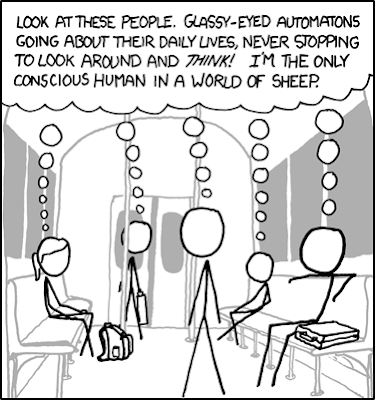
One of my favorite topics is I'M-SPECIAL-ism. Psychological research has repeatedly shown that most Americans overestimate their own abilities. This is one of the biggest hurdles to proper reasoning: the natural tendency to think that we're more unique--smarter, or more powerful, or prettier, or whatever--than we really are.

You've probably noticed that one of my favorite blogs is Overcoming Bias. Their mission statement is sublimely anti-I'M-SPECIAL-ist:

"How can we better believe what is true? While it is of course useful to seek and study relevant information, our minds are full of natural tendencies to bias our beliefs via overconfidence, wishful thinking, and so on. Worse, our minds seem to have a natural tendency to convince us that we are aware of and have adequately corrected for such biases, when we have done no such thing."

This may sound insulting, but one of the goals of this class is getting us to recognize that we're not as smart as we think we are. All of us. You. Me! That one. You again. Me again!

So I hope you'll join the campaign to end I'M-SPECIAL-ism.

Anti-I'M-SPECIAL-ism: No, You're Not